

![“Tanning exposes your skin to [ultraviolet (UV)] light, and UV light is a known carcinogen, which means it can alter your DNA,” Biotechnology and biology teacher Gillian Boyd said. “It can change the sequences of DNA bases. The more exposure you have, the more risk you have to develop [skin] cancer.”](https://smhsponyexpress.org/wp-content/uploads/2026/06/IMG_0071-1200x798.jpeg)






![Remakes [and film adaptations of books] are often criticized for being too repetitive and unnecessary.](https://smhsponyexpress.org/wp-content/uploads/2026/06/IMG_0193-1200x558.jpeg)







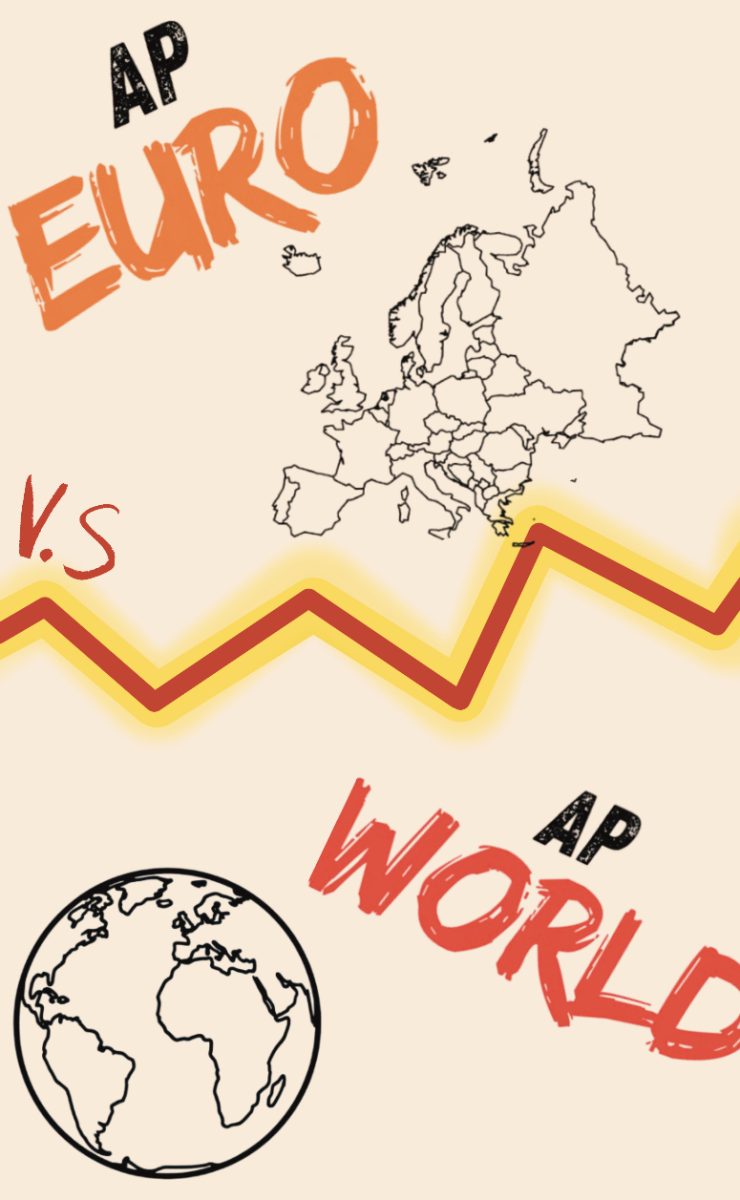
During freshman year, students have two Advanced Placement (AP) history classes they can take if they do not plan to take the regular World History course. They have the opportunity to choose AP European History (AP Euro) or AP World History (WHAP.)
Both classes, having a heavy course load, can prepare sophomores for AP US History (APUSH). APUSH is known for an extremely loaded curriculum, covering the history of the United States from 1491 to present day. WHAP studies the time range from 1200 to present, and does not go into much depth for topics because of the amount of regions the course covers, which is about six. AP Euro starts at 1450, around the time of the Renaissance, and goes up to the present day.
AP Euro, although focusing on European history, overlaps with some topics covered in APUSH, such as industrialization and the world wars. In their units, they focus on topics instead of time periods. That is where the two curriculums differ. Stella Craig, a junior, took AP Euro her sophomore year and is now taking APUSH.
“I think they are very different classes,” Craig said. “However, the information learned in [AP] Euro supports what you learn in APUSH, because, one, you learn some of the same things, especially around world wars, which are big in APUSH [in] the way governments work, and the diplomacy and relationships between European countries and the U.S. [which] was talked about a lot in AP Euro, which really prepared me for learning about it in APUSH So I had a little bit of background knowledge that could support what [I’m] learning in APUSH.”
AP World represents six regions of notable history, which is a significant difference from AP Euro’s demographic. When studying Africa, East Asia, Europe, South/Southeast Asia, the Americas, and Afro-Eurasia, there is not enough time to go in depth with each region. WHAP focuses on how the governments work and how the people responded, as well as trade routes. Junior Evie Snyder took WHAP her sophomore year.
“A lot of the topics that Mr. Lacy has brought up, [such as] the Great Depression and the world wars, we talked about the Axis powers and we talked a lot about industrialization all over the world,” Snyder said. “I feel like that really helped, like, prepare me for some of the stuff that we talk about in APUSH.”
I took WHAP my sophomore year, and from experience, I can definitely say that taking that class helped me a lot with the information taught in APUSH. The overlap between WHAP and APUSH that was most notable on my end is definitely the time spent covering the world wars and the Cold War. Though I haven’t taken the AP Exam for APUSH yet, the material covered is very similar, and WHAP is a really fun class to take in addition to helping with background information if one plans to enroll in APUSH their junior year.