![“Tanning exposes your skin to [ultraviolet (UV)] light, and UV light is a known carcinogen, which means it can alter your DNA,” Biotechnology and biology teacher Gillian Boyd said. “It can change the sequences of DNA bases. The more exposure you have, the more risk you have to develop [skin] cancer.”](https://smhsponyexpress.org/wp-content/uploads/2026/06/IMG_0071-1200x798.jpeg)

![Remakes [and film adaptations of books] are often criticized for being too repetitive and unnecessary.](https://smhsponyexpress.org/wp-content/uploads/2026/06/IMG_0193-1200x558.jpeg)

Hanukkah carries a lot of significance throughout the Jewish community and is celebrated by many students and faculty at San Marin High School. However, it is not celebrated the same by all Jewish people. Branches of Judaism celebrate the holiday differently, and some choose not to celebrate it at all.
Senior Maya Waldorf runs Tikkun Olam, a community service club rooted in Tikkun Olam, a Jewish principle that translates to “repair of the world,” referring to things people can do to make the world a better place.
“Judaism is a spectrum, so Reform is more on the relaxed side of Judaism, with Orthodox being on the really strict side,” Waldorf said. Typically, many Jewish people celebrate Hanukkah by spending time with family; however, some choose to celebrate Hanukkah by attending events at synagogues.
Hanukkah, or the Jewish Festival of Lights, has been celebrated by many people who practice Judaism or are of Jewish descent for over 2,000 years. This holiday honors the rededication of the Second Temple in Jerusalem, which was purified after the Syrian
Greeks, who wanted to stamp out Jewish practices, were driven out. When the temple was rededicated, a sealed jar of oil that was meant to last for one day and one night was found. It was used to light the menorah in the Second Temple, and miraculously lasted eight days and eight nights.
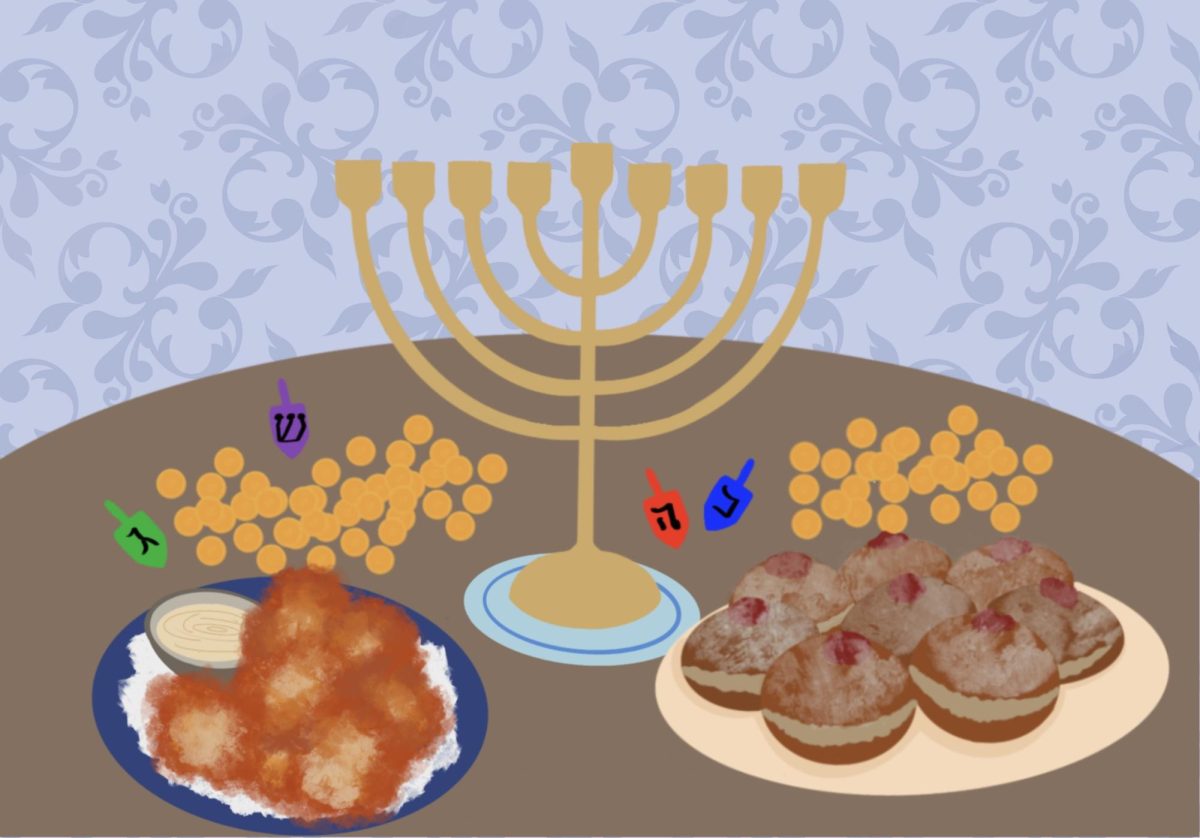
This was seen as a miracle by the Jewish people, creating the tradition to light a menorah, a nine-branch candelabra. Each night, one candle is lit by a designated candle called the shamash. In Hebrew, shamash translates to “helper,” serving to light the eight
candles throughout Hanukkah represent the eight days and nights during which the oil lasted.
Junior Bat-El Miller enjoys celebrating Hanukkah and partaking in the traditions.
“My favorite part about Hanukkah is probably lighting the menorah and feeling that connection and remembering the story,” Miller said.
Hanukkah carries a lot of meaning and significance, but it is not one of the most important holidays.
“Rosh Hashanah is the marking of a ten day period of reflection and repentance, and other holidays that follow this are Yom Kippur, Sukkot, and Simchat Torah,” Miller said. “These holidays hold higher religious signnificance because you can attone
for your actions and ask for forgiveness, whereas Hanukkah is more of a celebration of a certain event.”
Hanukkah is traditionally celebrated for eight nights and eight days. Its starting date is determined by the Hebrew lunar calendar. This year, it will be celebrated from Dec. 14 to Dec. 22.
It is typically celebrated by telling stories of the holiday, spending time with family, giving gifts, and playing dreidel. Traditional
foods fried with oil, such as latkes (potato pancakes) and sufganiyot (jelly-filled donuts), are very popular
during Hanukkah.
“It’s tradition to eat fried food because of the oil that lasted more than 24 hours, so we fry everything,” Waldorf said. “Hannukkah is more of a time where we can acknowledge our history of people coming in and trying to take over the Jewish land and us saying that no, we’re Jewish and we’re proud to be Jewish.”